Grades
One list per grade. Pick the grade you are working towards, tick the techniques as you learn them, and the bar shows how close you are.
Sitting a formal grading? The examinations section transcribes the real exam forms.
Each grade also has a flashcard deck of its syllabus, for learning the Japanese names between sessions.
Kai grades (Scotland) · JudoScotland
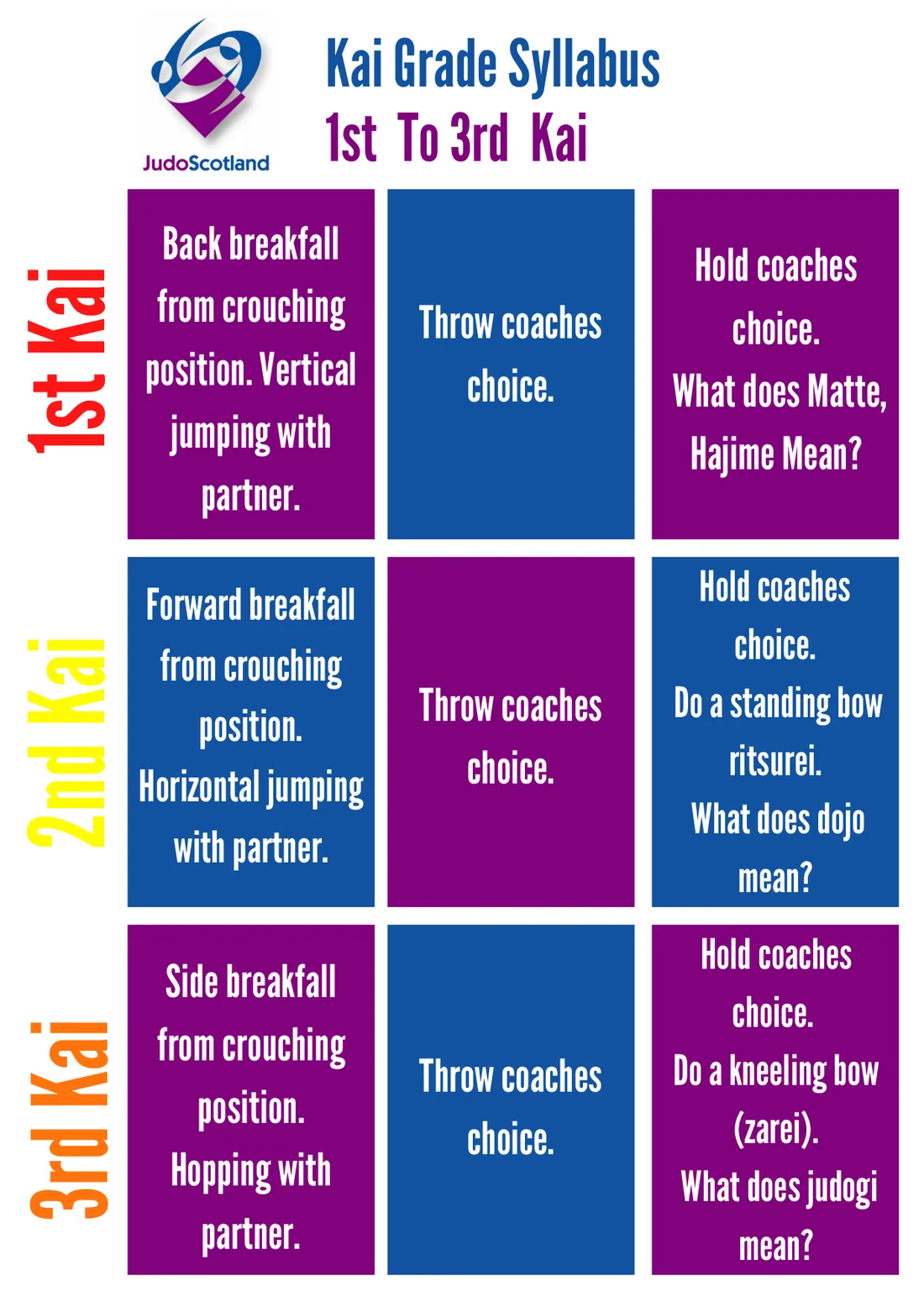
JudoScotland's Kai pathway: nine gradings for children aged 5 to 7, marked on one belt by a coloured stripe. At 8 a Kai holder transfers into the Mon system.
Kai is not regulated centrally. Your club's colours may differ.
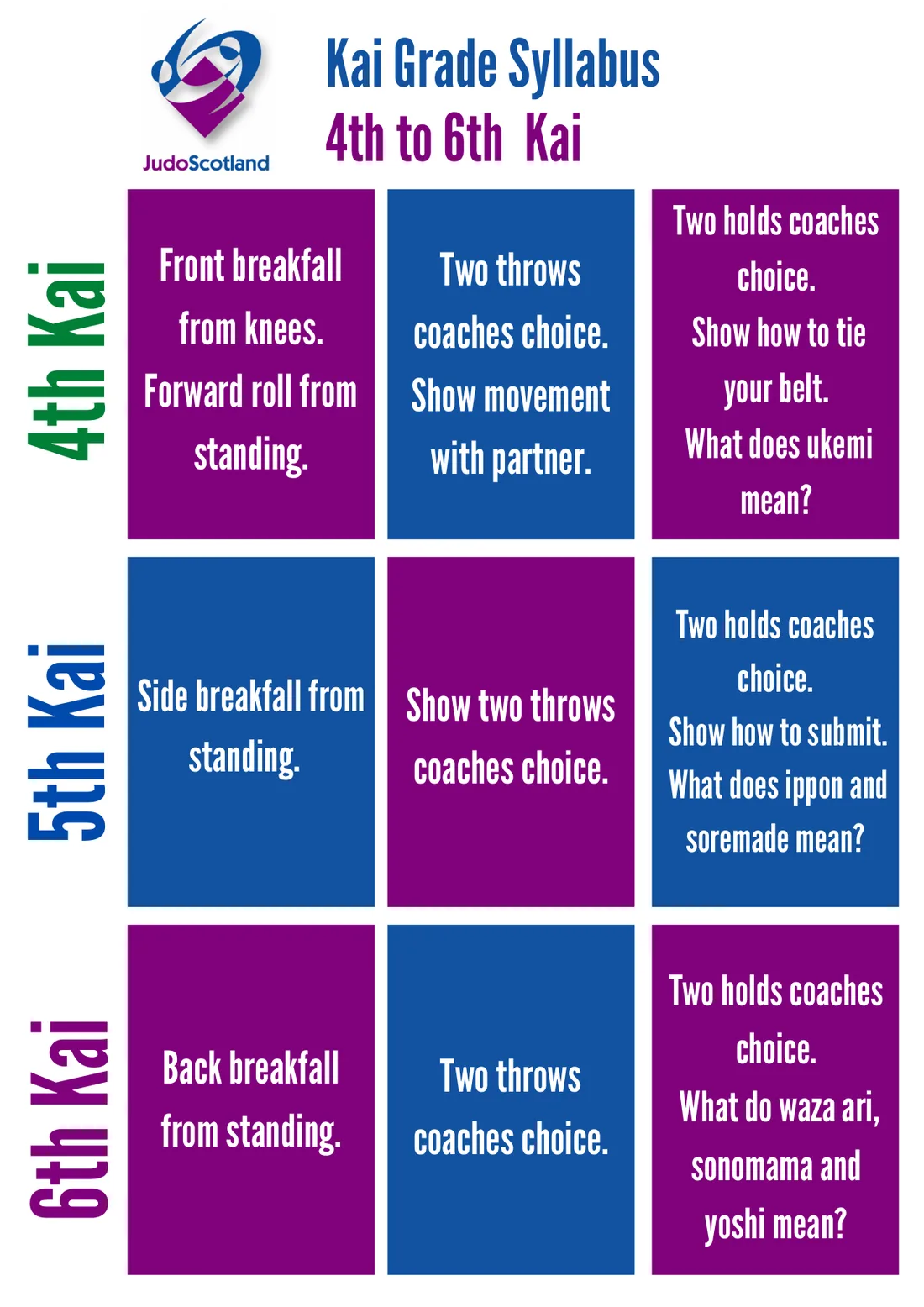
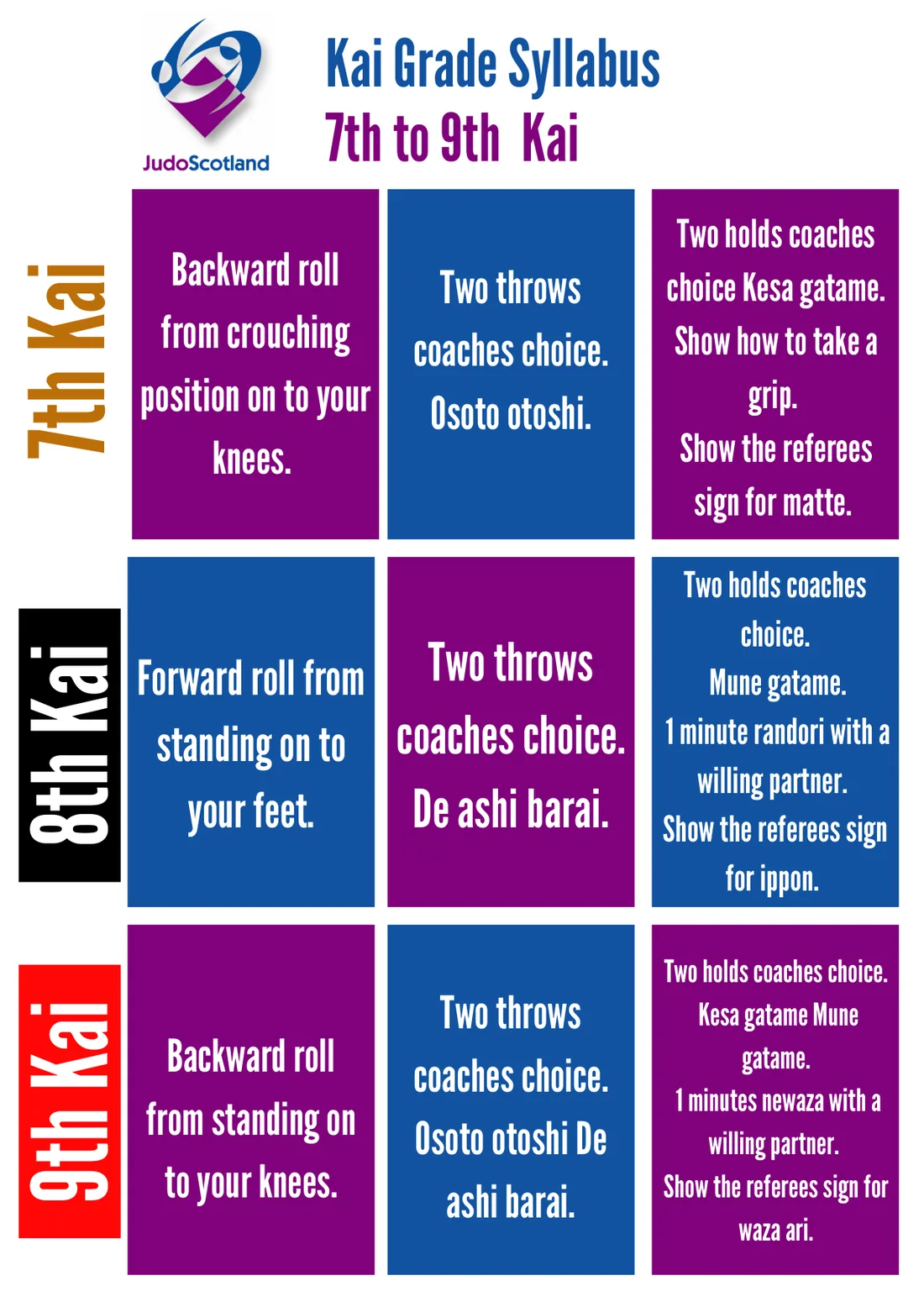
Syllabus posters:1st to 3rd Kai4th to 6th Kai7th to 9th Kai
- 1st KaiWhite belt with a red stripe · 2 techniques0 of 2 learned
- 2nd KaiWhite belt with a yellow stripe · 2 techniques0 of 2 learned
- 3rd KaiWhite belt with an orange stripe · 2 techniques0 of 2 learned
- 4th KaiWhite belt with a green stripe · 2 techniques0 of 2 learned
- 5th KaiWhite belt with a blue stripe · 2 techniques0 of 2 learned
- 6th KaiWhite belt with a purple stripe · 2 techniques0 of 2 learned
- 7th KaiWhite belt with a brown stripe · 4 techniques0 of 4 learned
- 8th KaiWhite belt with a black stripe · 4 techniques0 of 4 learned
- 9th KaiRed belt with a white stripe · 6 techniques0 of 6 learned
United Kingdom


This space is open. This country's pages can name one sponsor. No other sponsorship appears on them. How sponsorship works.
Mon grades · British Judo Association
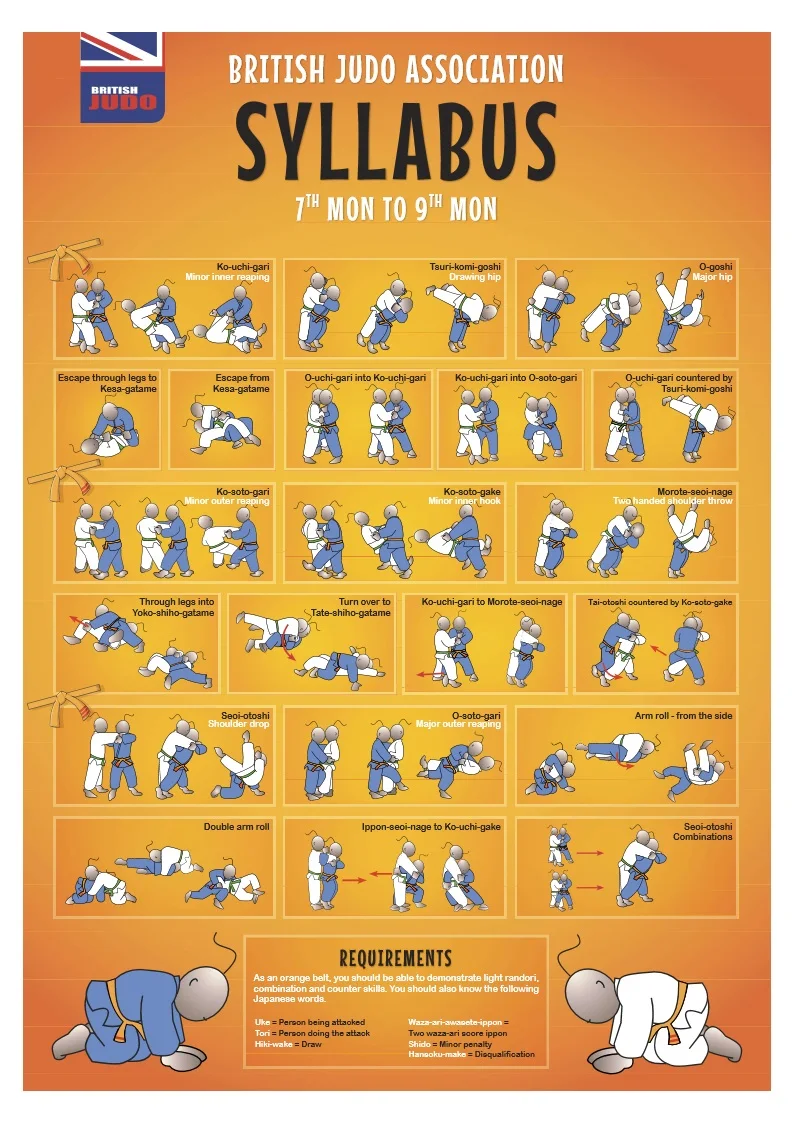
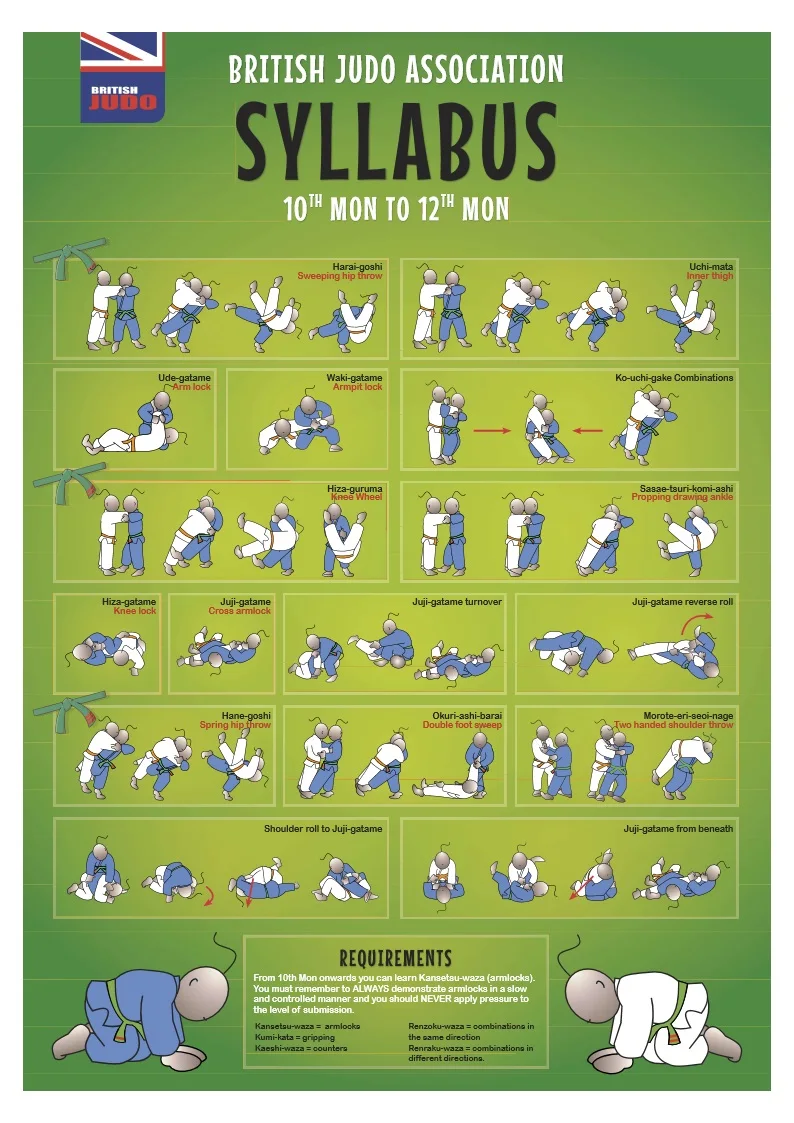
The junior grading pathway of the British Judo Association: eighteen Mon grades from red to brown belt. Skills that are not single techniques (breakfalls, escapes, turnovers, grips, randori) are also available to review on the site.
Syllabus posters:1st to 3rd Mon4th to 6th Mon7th to 9th Mon10th to 12th Mon
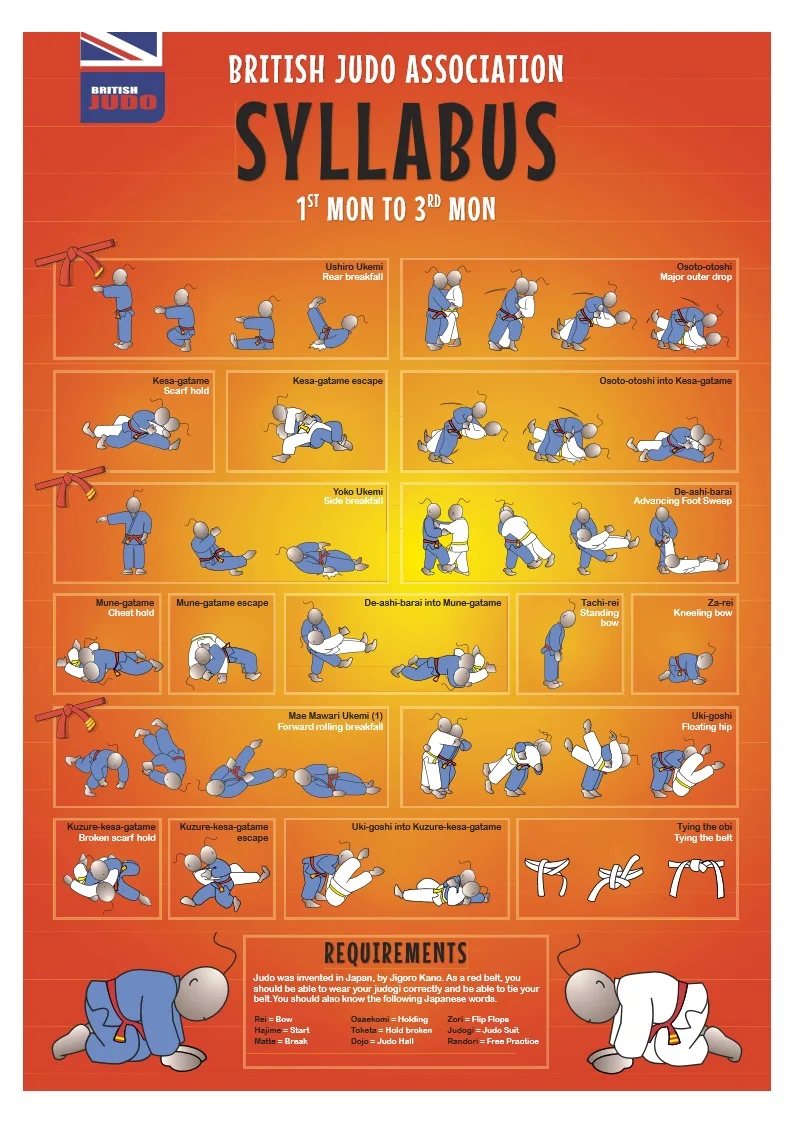
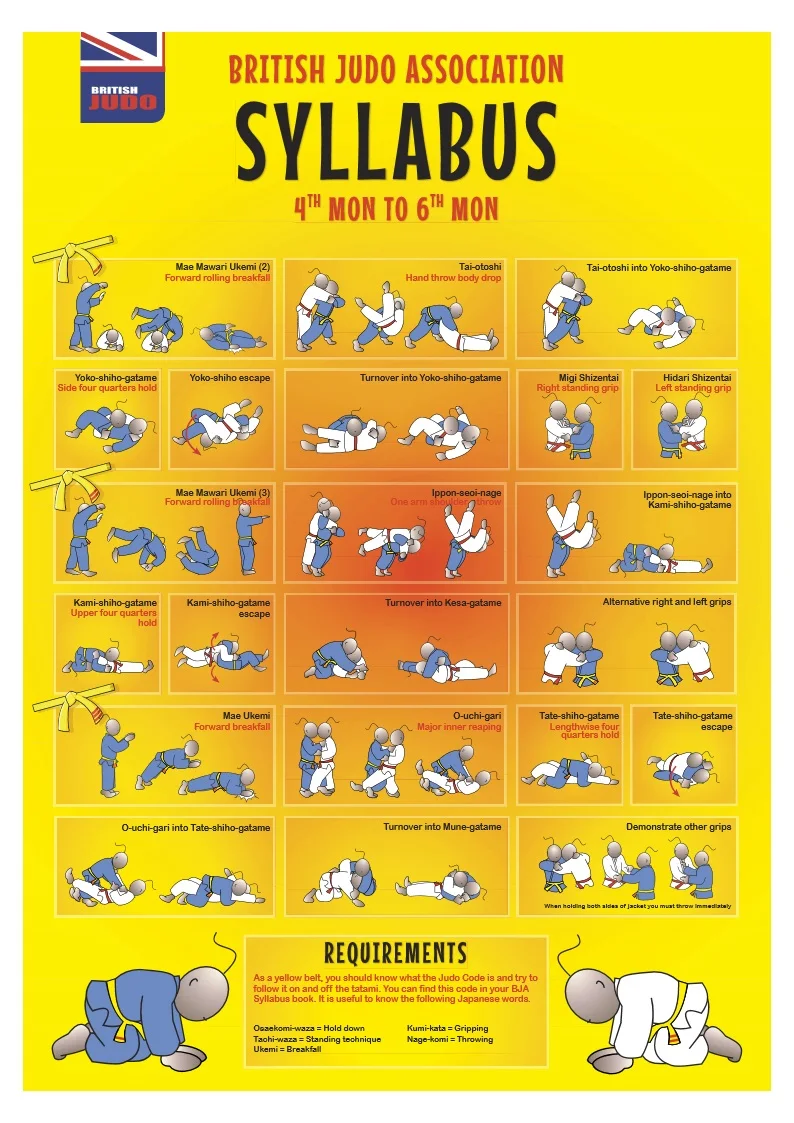
- 1st MonRed belt · 2 techniques0 of 2 learned
- 2nd MonRed belt · 2 techniques0 of 2 learned
- 3rd MonRed belt · 2 techniques0 of 2 learned
- 4th MonYellow belt · 2 techniques0 of 2 learned
- 5th MonYellow belt · 3 techniques0 of 3 learned
- 6th MonYellow belt · 3 techniques0 of 3 learned
- 7th MonOrange belt · 6 techniques0 of 6 learned
- 8th MonOrange belt · 7 techniques0 of 7 learned
- 9th MonOrange belt · 4 techniques0 of 4 learned
- 10th MonGreen belt · 6 techniques0 of 6 learned
- 11th MonGreen belt · 4 techniques0 of 4 learned
- 12th MonGreen belt · 4 techniques0 of 4 learned
- 13th MonBlue belt · 5 techniques0 of 5 learned
- 14th MonBlue belt · 5 techniques0 of 5 learned
- 15th MonBlue belt · 5 techniques0 of 5 learned
- 16th MonBrown belt · 5 techniques0 of 5 learned
- 17th MonBrown belt · 6 techniques0 of 6 learned
- 18th MonBrown belt · 5 techniques0 of 5 learned
United Kingdom
This space is open. This country's pages can name one sponsor. No other sponsorship appears on them. How sponsorship works.
Kyu grades (Scotland) · JudoScotland
JudoScotland's Kyu grade pathway: six grades from red to brown belt, open to judoka from 14 years of age. Promotion is based on technical knowledge and understanding with no contest requirement; a structured Randori element grows through the grades.
- 6th KyuRed belt · 6 techniques0 of 6 learned
- 5th KyuYellow belt · 8 techniques0 of 8 learned
- 4th KyuOrange belt · 15 techniques0 of 15 learned
- 3rd KyuGreen belt · 11 techniques0 of 11 learned
- 2nd KyuBlue belt · 14 techniques0 of 14 learned
- 1st KyuBrown belt · 14 techniques0 of 14 learned
United Kingdom
This space is open. This country's pages can name one sponsor. No other sponsorship appears on them. How sponsorship works.
Dan grades · British Judo Association
The senior grades of the British Judo Association, 1st to 6th Dan, as they stand for promotions from 1 January 2026. 1st to 5th Dan are examined; 6th Dan is by application. Two routes reach them, competitive and technical, and the syllabus below is common to both: the routes differ in the paper that examines a candidate and in what they must have done to be eligible, not in the techniques they have to be able to do. The hundred techniques the Kodokan recognises are divided into five sets of twenty, one to a dan grade. A candidate demonstrates the whole set for the grade being taken, five techniques of their own choice from each set already passed, and then performance skills, where the technique is theirs to choose from any of the hundred: throws linked into combinations and counters, groundwork combined, escaped or entered, and standing judo carried into groundwork. Each grade below lists the techniques it can be examined on by name, which is its own twenty and every set beneath it; the performance sections range over all hundred. Both papers, with their marks and pass marks, are in the examinations section, one per grade per route. The BJA recently replaced their 1982 scheme, built on 67 techniques, to teach the wider Kodokan curriculum and to bring its dan grade policy into line with IJF policy.
- 1st DanBlack belt · 20 techniques0 of 20 learned
- 2nd DanBlack belt · 40 techniques0 of 40 learned
- 3rd DanBlack belt · 60 techniques0 of 60 learned
- 4th DanBlack belt · 80 techniques0 of 80 learned
- 5th DanBlack belt · 100 techniques0 of 100 learned
- 6th DanRed belt with a white stripe · 0 techniques0 of 0 learned
United Kingdom
This space is open. This country's pages can name one sponsor. No other sponsorship appears on them. How sponsorship works.
Dan grades · Real Federación Española de Judo y Deportes Asociados
The Spanish federation's dan grade programme, from 1st to 5th Dan, as approved in October 2025 and in force from 1 January 2026. Each grade sets its own list of standing and groundwork techniques, its fundamentals, a tokui waza the candidate develops at length, and one kata.
- 1st DanBlack belt · 23 techniques0 of 23 learned
- 2nd DanBlack belt · 22 techniques0 of 22 learned
- 3rd DanBlack belt · 19 techniques0 of 19 learned
- 4th DanBlack belt · 19 techniques0 of 19 learned
- 5th DanBlack belt · 17 techniques0 of 17 learned
- 6th DanBlack belt · 0 techniques0 of 0 learned
Spain
This space is open. This country's pages can name one sponsor. No other sponsorship appears on them. How sponsorship works.
Junior kyu grades (USA Judo) · USA Judo
USA Judo's junior rank program: ten kyu grades from 10th Kyu, a white/yellow belt, to 1st Kyu, a purple belt, with a two-colour half-belt between each full colour. The guidelines present it as a teaching reference that instructors adapt to each athlete, assuming a start at 5 or 6 years old and half a belt promotion a year.
The guidelines name each half-belt by two colours, such as white/yellow, without saying how it is worn.
- 10th KyuWhite belt with a yellow stripe · 3 techniques0 of 3 learned
- 9th KyuYellow belt · 5 techniques0 of 5 learned
- 8th KyuYellow belt with an orange stripe · 4 techniques0 of 4 learned
- 7th KyuOrange belt · 3 techniques0 of 3 learned
- 6th KyuOrange belt with a green stripe · 5 techniques0 of 5 learned
- 5th KyuGreen belt · 3 techniques0 of 3 learned
- 4th KyuGreen belt with a blue stripe · 3 techniques0 of 3 learned
- 3rd KyuBlue belt · 4 techniques0 of 4 learned
- 2nd KyuBlue belt with a purple stripe · 4 techniques0 of 4 learned
- 1st KyuPurple belt · 1 technique0 of 1 learned
United States
This space is open. This country's pages can name one sponsor. No other sponsorship appears on them. How sponsorship works.
Dan grades (USA Judo) · USA Judo
USA Judo's dan grades, from 1st to 10th Dan, awarded on a recommendation processed through the candidate's state member organisation. Each grade from 1st to 8th Dan sets a minimum age, a minimum time in grade that contest points or a category of achievement can shorten, and recommended minimum requirements that include kata. The procedures treat time in grade as a minimum benchmark for review, and promotion is not automatic.
The procedures do not name belt colours. The colours shown are the international convention.
- 1st DanBlack belt · 0 techniques0 of 0 learned
- 2nd DanBlack belt · 0 techniques0 of 0 learned
- 3rd DanBlack belt · 0 techniques0 of 0 learned
- 4th DanBlack belt · 0 techniques0 of 0 learned
- 5th DanBlack belt · 0 techniques0 of 0 learned
- 6th DanRed belt with a white stripe · 0 techniques0 of 0 learned
- 7th DanRed belt with a white stripe · 0 techniques0 of 0 learned
- 8th DanRed belt with a white stripe · 0 techniques0 of 0 learned
- 9th DanRed belt · 0 techniques0 of 0 learned
- 10th DanRed belt · 0 techniques0 of 0 learned
United States
This space is open. This country's pages can name one sponsor. No other sponsorship appears on them. How sponsorship works.
Junior kyu grades (USJF) · United States Judo Federation
The United States Judo Federation's recommended junior pathway for judoka aged 16 and under: eleven kyu grades from white to purple belt, then Shodan. Each grade covers personal development, vocabulary, history, rules and technique, with shime waza and kansetsu waza added at the older ages.
The handbook prints each in-between grade as a two-colour belt, for example White/Yellow, or under the Mon system as the lower colour with a stripe of the higher; either is allowed.
- Juichikyu (Rokkyu)White belt · 0 techniques0 of 0 learned
- Jukyu (Adv. Rokkyu)White belt with a yellow stripe · 4 techniques0 of 4 learned
- Kyukyu (Gokyu)Yellow belt · 4 techniques0 of 4 learned
- Hachikyu (Adv. Gokyu)Yellow belt with an orange stripe · 3 techniques0 of 3 learned
- Nanakyu (Yonkyu)Orange belt · 7 techniques0 of 7 learned
- Rokkyu (Adv. Yonkyu)Orange belt with a green stripe · 6 techniques0 of 6 learned
- Gokyu (Sankyu)Green belt · 4 techniques0 of 4 learned
- Yonkyu (Adv. Sankyu)Green belt with a blue stripe · 8 techniques0 of 8 learned
- Sankyu (Nikyu)Blue belt · 8 techniques0 of 8 learned
- Nikyu (Adv. Nikyu)Blue belt with a purple stripe · 5 techniques0 of 5 learned
- IkkyuPurple belt · 8 techniques0 of 8 learned
- ShodanBlack belt · 7 techniques0 of 7 learned
United States
This space is open. This country's pages can name one sponsor. No other sponsorship appears on them. How sponsorship works.
Senior kyu grades (USJF) · United States Judo Federation
The United States Judo Federation's senior kyu grades for judoka aged 17 and over: six grades from Rokkyu (white belt) to Ikkyu (brown belt). From Sankyu, time in grade depends on whether the candidate is a competitor and on promotion points.
- Rokkyu (6th Kyu)White belt · 0 techniques0 of 0 learned
- Gokyu (5th Kyu)Green belt · 9 techniques0 of 9 learned
- Yonkyu (4th Kyu)Blue belt · 11 techniques0 of 11 learned
- Sankyu (3rd Kyu)Brown belt · 15 techniques0 of 15 learned
- Nikyu (2nd Kyu)Brown belt · 15 techniques0 of 15 learned
- Ikkyu (1st Kyu)Brown belt · 10 techniques0 of 10 learned
United States
This space is open. This country's pages can name one sponsor. No other sponsorship appears on them. How sponsorship works.
Dan grades (USJF) · United States Judo Federation
The United States Judo Federation's dan grades, from Shodan to Judan. Each Yudanshakai examines within its own promotion authority; each grade sets a minimum age, a time in grade that depends on competitor status and promotion points, techniques, kata and service requirements.
Rokudan to Hachidan wear a red and white belt, shown here as red with a white stripe.
- Shodan (1st Dan)Black belt · 9 techniques0 of 9 learned
- Nidan (2nd Dan)Black belt · 7 techniques0 of 7 learned
- Sandan (3rd Dan)Black belt · 7 techniques0 of 7 learned
- Yodan (4th Dan)Black belt · 9 techniques0 of 9 learned
- Godan (5th Dan)Black belt · 0 techniques0 of 0 learned
- Rokudan (6th Dan)Red belt with a white stripe · 0 techniques0 of 0 learned
- Shichidan (7th Dan)Red belt with a white stripe · 0 techniques0 of 0 learned
- Hachidan (8th Dan)Red belt with a white stripe · 0 techniques0 of 0 learned
- Kudan (9th Dan)Red belt · 0 techniques0 of 0 learned
- Judan (10th Dan)Red belt · 0 techniques0 of 0 learned
United States
This space is open. This country's pages can name one sponsor. No other sponsorship appears on them. How sponsorship works.
Junior ranks (USJA) · United States Judo Association
The United States Judo Association's junior ranks, JR1 to JR12, with a minimum time in grade and class attendance for each. A candidate passes a general knowledge and vocabulary paper, completed down to the rank being tested for, and then demonstrates a set number of techniques from each technical list; coach and student agree the techniques beforehand, and the list below each grade is the pool they choose from. Junior ranks are signed off by a Shodan or higher, and clubs or instructors may add requirements of their own.
Colours are from the association's promotion page, which lists 01 to 12 and gives the same colour to several ranks without saying how they are told apart.
- Junior 1st Degree (JR1)Yellow belt · 5 techniques, chosen from the syllabus lists0 of 5 learned
- Junior 2nd Degree (JR2)Yellow belt · 9 techniques, chosen from the syllabus lists0 of 9 learned
- Junior 3rd Degree (JR3)Orange belt · 14 techniques, chosen from the syllabus lists0 of 14 learned
- Junior 4th Degree (JR4)Orange belt · 20 techniques, chosen from the syllabus lists0 of 20 learned
- Junior 5th Degree (JR5)Green belt · 26 techniques, chosen from the syllabus lists0 of 26 learned
- Junior 6th Degree (JR6)Green belt · 31 techniques, chosen from the syllabus lists0 of 31 learned
- Junior 7th Degree (JR7)Blue belt · 34 techniques, chosen from the syllabus lists0 of 34 learned
- Junior 8th Degree (JR8)Blue belt · 41 techniques, chosen from the syllabus lists0 of 41 learned
- Junior 9th Degree (JR9)Purple belt · 46 techniques, chosen from the syllabus lists0 of 46 learned
- Junior 10th Degree (JR10)Purple belt · 51 techniques, chosen from the syllabus lists0 of 51 learned
- Junior 11th Degree (JR11)Purple belt · 55 techniques, chosen from the syllabus lists0 of 55 learned
- Junior 12th Degree (JR12)Purple belt · 59 techniques, chosen from the syllabus lists0 of 59 learned
United States
This space is open. This country's pages can name one sponsor. No other sponsorship appears on them. How sponsorship works.
Senior ranks, Kyu to Sandan (USJA) · United States Judo Association
The United States Judo Association's senior ranks from 6th Kyu to 3rd Dan, from a minimum age of 14. To 1st Dan a candidate passes a general knowledge and vocabulary paper and then demonstrates a set number of techniques from each technical list, agreed with the coach beforehand; the list below each grade is the pool they choose from, and the kyu grades from Sankyu add parts of an online Nage-no-kata exam. 2nd and 3rd Dan each add a kata, a full list of throws to pass one by one, and a refereeing or coaching certification. Clubs or instructors may add requirements of their own.
- 6th Kyu (Rokkyu)Yellow belt · 14 techniques, chosen from the syllabus lists0 of 14 learned
- 5th Kyu (Gokyu)Orange belt · 22 techniques, chosen from the syllabus lists0 of 22 learned
- 4th Kyu (Yonkyu)Green belt · 31 techniques, chosen from the syllabus lists0 of 31 learned
- 3rd Kyu (Sankyu)Brown belt · 42 techniques, chosen from the syllabus lists0 of 42 learned
- 2nd Kyu (Nikyu)Brown belt · 53 techniques, chosen from the syllabus lists0 of 53 learned
- 1st Kyu (Ikkyu)Brown belt · 66 techniques, chosen from the syllabus lists0 of 66 learned
- 1st Dan (Shodan)Black belt · 78 techniques, chosen from the syllabus lists0 of 78 learned
- 2nd Dan (Nidan)Black belt · 20 techniques0 of 20 learned
- 3rd Dan (Sandan)Black belt · 8 techniques0 of 8 learned
United States
This space is open. This country's pages can name one sponsor. No other sponsorship appears on them. How sponsorship works.
High dan ranks (USJA) · United States Judo Association
The United States Judo Association's ranks from 4th to 10th Dan. By 4th Dan a candidate has shown technical proficiency in the association's curriculum, and promotion from there is judged on service to the development of judo through the association rather than by examination. 4th and 5th Dan are instructor grades, 6th to 8th Dan are awarded for mastery of the curriculum and extraordinary service, and 9th and 10th Dan are reserved for a lifetime of work at national and international level. The Promotion Board, made up of 6th Dan holders and above, looks at each application as a whole, with most weight on service since the last promotion; a sub-committee reviews 4th and 5th Dan, and ranks above 8th Dan also need the approval of the Board of Directors.
The forms print two colours for 4th to 8th Dan without saying how they are arranged on the belt.
- 4th Dan (Yodan)Black belt with a red stripe · 0 techniques0 of 0 learned
- 5th Dan (Godan)Black belt with a red stripe · 0 techniques0 of 0 learned
- 6th Dan (Rokudan)Red belt with a white stripe · 0 techniques0 of 0 learned
- 7th Dan (Shichidan)Red belt with a white stripe · 0 techniques0 of 0 learned
- 8th Dan (Hachidan)Red belt with a white stripe · 0 techniques0 of 0 learned
- 9th Dan (Kudan)Red belt · 0 techniques0 of 0 learned
- 10th Dan (Judan)Red belt · 0 techniques0 of 0 learned
United States
This space is open. This country's pages can name one sponsor. No other sponsorship appears on them. How sponsorship works.